
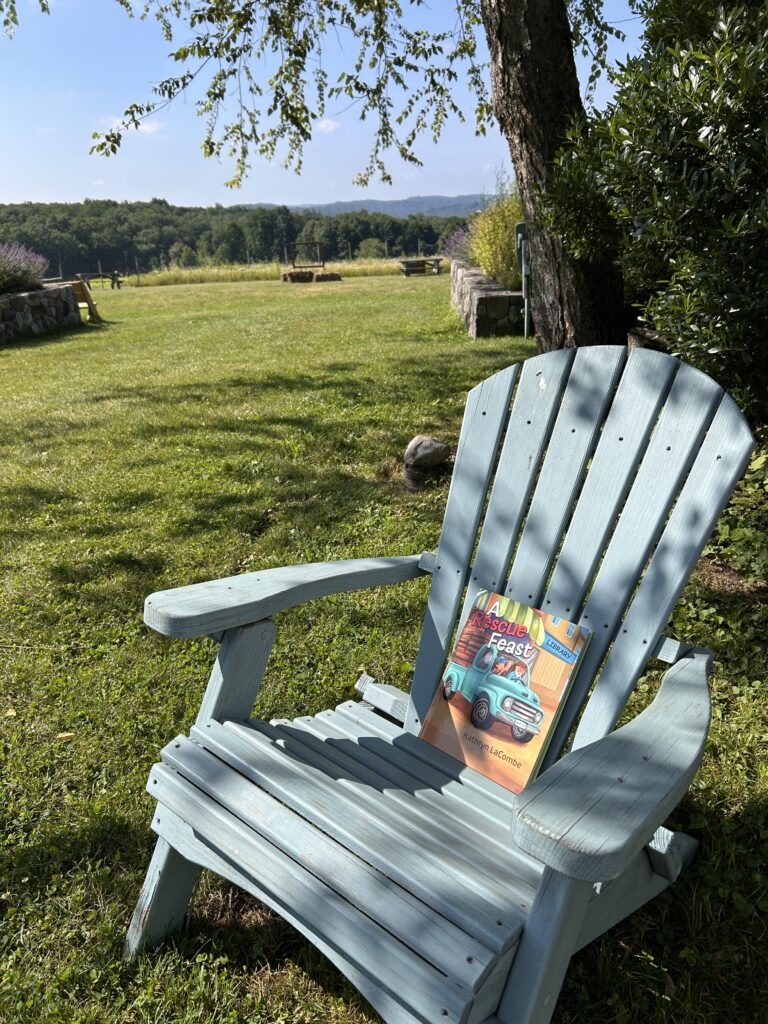
Somewhere between reading A Rescue Feast under a tree at a working farm, tasting rescued tomatoes with children at a farmers market, and seeing the book included in an exhibit about our local sustainable food system, I realized something:
A Rescue Feast has been moving through the food system.
When the book was published, I imagined it going to bookstores, libraries, schools, book fairs, and readers’ homes.
It has gone to those places. But it has also traveled to farms, gardens, markets, cooking schools, and community food programs…places where food is grown, prepared, rescued, and shared.
Along the way, I began to see the connection between the story I had written and the way I teach children about food.
What is the food system?
“The food system” can sound like a big, complicated term. At its simplest, it is the story of how food moves: how it is grown, harvested, transported, sold, prepared, and eaten…and what happens to the food that isn’t eaten.
Farms, markets, kitchens, schools, food pantries, food-rescue organizations, and compost piles are all part of the system.
Every time we grow something, prepare a meal, save a leftover, share extra food, or compost a peel, we are participating in the food system.
One simple way to begin seeing that system is to look at a piece of food and ask:
What can happen next?
A tomato ripens on the vine. It can be harvested, taken to a market, selected by a family, and carried home for dinner.
What if there are more tomatoes than the farmer can sell? What if they aren’t the right size or shape for a store shelf? What if they are ready to be eaten but no longer have an obvious destination?
Food rescue asks us to pause before deciding that the next step is “waste.”
What else is possible?
Where the story began
The roots of A Rescue Feast reach back much further than the book itself.
My father always grew tomatoes. One summer, when my son was a toddler, the two of them were together in his garden. The vines were filled with ripe, red tomatoes, and my son loved picking them. When my father noticed a storm brewing on the horizon, he told him they needed to gather the ripe tomatoes before the rain ruined them.
So they did.
Years later, on our first day volunteering with Second Chance Foods, we chopped a huge donation of tomatoes and froze them to be used later. Once again, tomatoes that might otherwise have been lost were gathered and given somewhere else to go.
Eventually, I became Culinary Director at Second Chance Foods. As I looked for ways to explain our work outside the kitchen, the idea for a children’s book began to take shape.
Those experiences came together in Billy’s story. In A Rescue Feast, Billy sees that his grandfather’s ripening tomatoes may be lost in a summer storm. His actions lead him into a larger world of rescued food, community helpers, cooking, and sharing.
When the story leaves the page
Soon after the book came out, I began to see that idea traveling beyond Billy’s story.
In April, Lori, a kindergarten teacher, read A Rescue Feast to her students. She brought in strawberries from her refrigerator that were looking less than perfect. After the story, she showed the strawberries to the children and asked what they thought they should do with them.
“Rescue them!” they said.
So they did.
The children examined the tiny seeds on the outside of the strawberries and decided to plant them to see if they would grow. A few imperfect strawberries had become an opportunity to notice, rescue, investigate, and plant.
The children looked at real food, recognized that its story wasn’t over, and decided for themselves what could happen next.
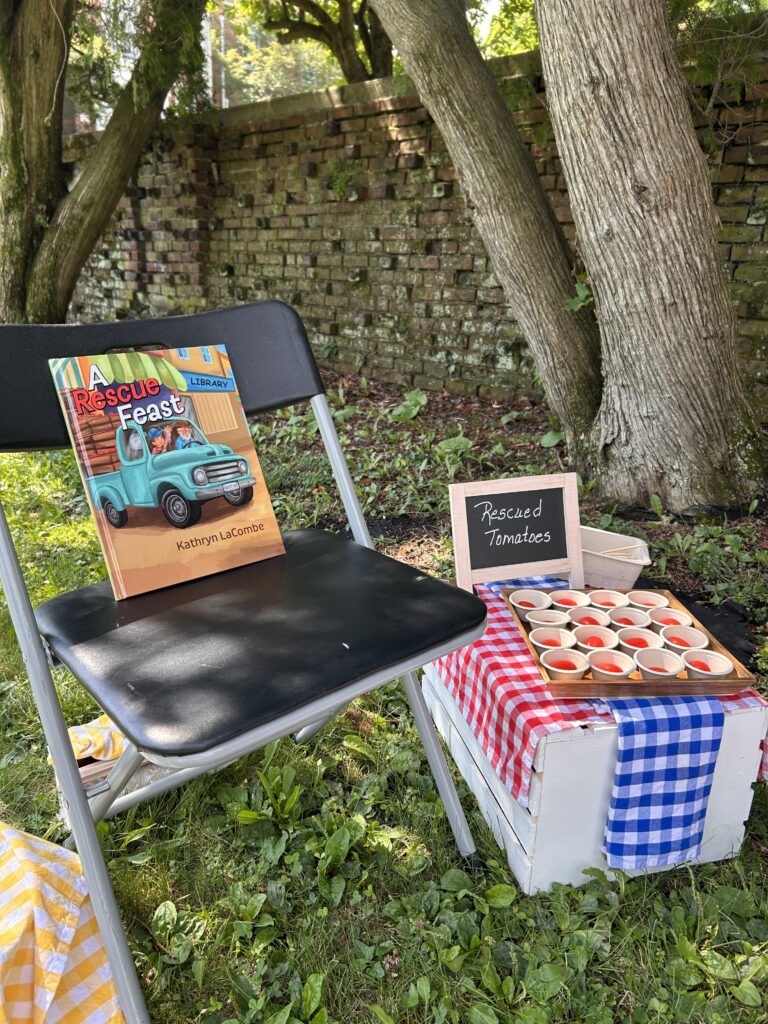
The book continued moving through the food system. Children explored seeds at Hilltop Hanover Farm, regrew green onions after a reading at Glynwood Farm, tasted rescued tomatoes at the Cornwall Farmers Market, and sorted, tasted, and regrew food at Bedford Playhouse.
In each place, the book offered a different way into the system: grow something, taste something, notice its value, or give it another chance.
Not every place the book travels, however, is somewhere food physically moves. Some are places where ideas about food move.
Libraries, classrooms, gardens, and cooking programs give children language for understanding the food around them. The educators using the book can carry those ideas to children I may never meet.
One moment brought that realization into particularly sharp focus.
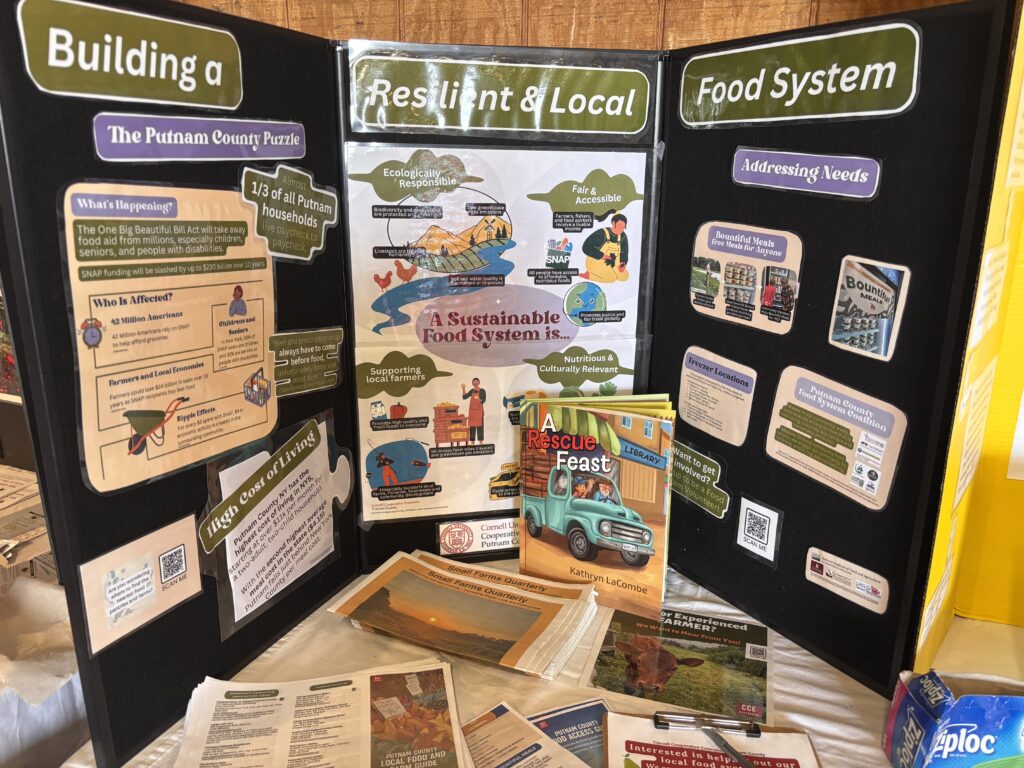
At the Putnam County Fair, Cornell Cooperative Extension created a display titled “Building a Resilient & Local Food System.” In front of the central panel explaining what makes a food system sustainable stood a copy of A Rescue Feast, surrounded by information about local farms, food access, community meals, and other Putnam County resources.
I hadn’t asked for the book to be included. Someone else looked at this children’s story and decided that it belonged there.
Seeing it positioned as part of the display helped me understand that A Rescue Feast was becoming one way to bring children—and the adults who teach them—into the larger food-system conversation.
A child’s place in the system
This fall, children at Reed Memorial Library won’t only hear a story about food rescue. They will pack rescued ingredients for sweet potato–apple soup into produce bags, then decorate the recipe cards and labels that accompany them. Each bag will carry the message: “Packed with care by young food rescuers at Reed Memorial Library.”
The completed soup bags will go to Gilead Food Pantry, where families can choose them during regular pantry hours.
Unlike a “drop and go” food drive, the soup-bag project gives children an active role. The bags are intentional: rescued ingredients are gathered into something useful, accompanied by a recipe, and prepared with the people receiving them in mind.
The children will move from hearing about food rescue to participating in it.
At Hilltop Hanover Farm, I’ll introduce three- and four-year-olds to the food system through the same question:
What can happen next?
An apple is growing on the tree. We pick it.
The apple has a bruise. We can still eat it or cook with it.
We have extra food. We can share it.
Only the apple core is left. It can go into the compost and eventually help something new grow.
That is a food system, explained at a preschooler’s scale.
Children don’t have to understand the entire system before they can find their place in it. Growing, tasting, noticing, rescuing, sharing, and composting are all child-sized ways of participating in a very big food system.
What can happen next?
I thought I was taking a children’s book to readings and programs.
Instead, I’ve watched it make its way through farms, gardens, markets, kitchens, classrooms, libraries, and community food programs…sometimes carried by me and, increasingly, carried forward by other people.
Billy participates in the food system in his story.
Now the book is inviting real children to discover that they can participate in theirs.
Perhaps that is what I most hope A Rescue Feast leaves behind: not simply an understanding of food rescue, but a habit of noticing.
When food is plentiful, imperfect, left over, or seemingly at the end of its usefulness, we can pause before deciding its story is over.
And ask one more question:
What can happen next?