
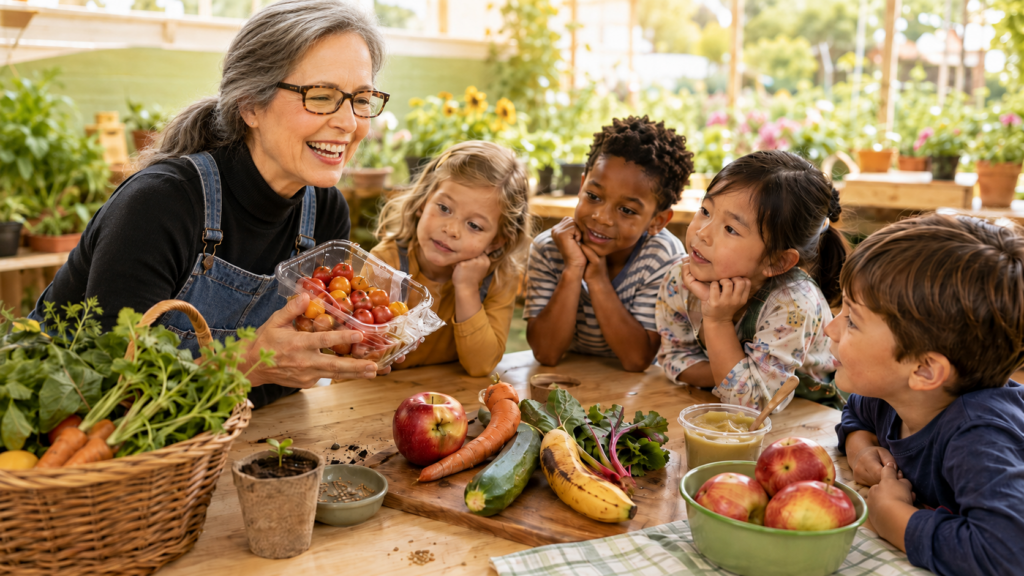
Simple words, thoughtful questions, and hands-on activities for parents, teachers, and librarians
A container of grape tomatoes can offer young children a simple introduction to food rescue.
The tomatoes may be bright, fresh, and delicious, but the container is dented or the plastic covering has pulled away. A grocery store may no longer be able to sell them, even though the food inside is still good.
For a young child, this creates a clear and understandable question:
What could still be done with this food?
Food rescue touches on large subjects, including food waste, hunger, sustainability, and community care. But young children do not need to understand the entire food system before they can begin thinking about food differently.
They can begin with one hopeful idea:
Sometimes good food needs a second chance.
Through my work in a food-rescue kitchen and my programs based on A Rescue Feast, I have found that children understand food rescue most readily when they can see, touch, taste, sort, plant, or prepare something themselves.
New to the subject? You can begin with my introduction to What is Food Rescue and Why It Matter. This article focuses specifically on how parents, teachers, librarians, and community educators can introduce the idea to young children.
Start with Real Food
Young children learn best when an idea is connected to something they can see.
Show them something familiar:
- A tomato with a soft spot
- A crooked carrot
- An apple with a bruise
- A package that is damaged even though the food inside is still good
- More produce than a farm, store, or family can use
Then ask simple questions:
- Does this still look good to eat?
- What could we make with it?
- Does food need to look perfect to be useful?
- What else could happen to it?
- Who might be able to use it?
These questions give children permission to notice, wonder, and offer ideas.
Food rescue becomes something they can think about—not a problem they are expected to solve.
Use Simple, Hopeful Language
When I talk with young children about food rescue, I keep the explanation honest but reassuring.
I might say:
Sometimes farms, stores, and restaurants have food that is still good but cannot be sold or used. Food rescuers help give that food another chance. They bring it somewhere it can be shared, prepared, or eaten instead of being thrown away.
For very young children, the explanation can be even simpler:
This food is still good. It just needs someone to help it find its next place.
The emphasis is not on frightening children with the size of food waste or hunger.
The emphasis is on what people can do:
- Notice that food still has value
- Find another use for it
- Prepare it
- Share it
- Compost what truly cannot be eaten
Children readily understand the idea of helping something get a second chance.
Focus on What Is Still Possible
One of the most useful questions adults can ask is:
What could we make with this?
A bruised apple may become applesauce.
Very ripe bananas may become muffins or smoothies.
Extra tomatoes may become salsa, soup, or sauce.
Green onions may be placed in water and grown again.
Food scraps that cannot be eaten may become compost that helps new food grow.
This approach shifts the conversation away from what appears wrong with the food and toward what is still possible.
That is at the heart of food rescue.
Avoid Making Children Feel Responsible for the Problem
Young children should leave a food-rescue conversation feeling curious and capable—not guilty or burdened.
They do not need to hear that it is their responsibility to solve food waste or hunger.
They do not need frightening statistics.
They do not need to feel ashamed if food has ever been wasted in their home.
Instead, adults can focus on gratitude, attention, and small actions.
You might say:
We cannot save every piece of food, but we can pay attention and make thoughtful choices when we can.
This gives children a healthy sense of participation without placing an adult-sized problem on their shoulders.
Let Children Use Their Senses
Food rescue becomes more memorable when children can experience it.
They might:
- Look at an oddly shaped vegetable
- Smell a ripe piece of fruit
- Taste something made with rescued ingredients
- Open a tomato and discover the seeds inside
- Sort pictures into rescue, compost, and recycling categories
- Plant a seed
- Regrow a vegetable scrap
- Help prepare a simple snack
A child who tastes applesauce made from bruised apples understands food rescue differently than a child who only hears a definition.
The lesson becomes concrete:
The apple was not useless. It became something delicious.
Ask Questions That Encourage Observation
Open-ended questions help children reach the idea themselves.
Try asking:
- What do you notice?
- Is this food still safe to eat?
- Does it need to look perfect?
- What could we make with it?
- Could it be shared?
- Could it be planted or regrown?
- What should happen if it truly cannot be eaten?
- Who could help this food find its next place?
There is not always one correct answer.
The goal is to help children begin thinking about food as something with a journey, a purpose, and more than one possible destination.
Introduce the Helpers
Food rescue is not only a story about food. It is also a story about people.
Farmers, grocery store workers, drivers, volunteers, cooks, gardeners, pantry workers, and neighbors may all help food reach its next destination.
Ask children:
- Who grew this food?
- Who noticed that it could still be used?
- Who helped move it?
- Who prepared it?
- Who might eat it?
- What could happen to the scraps afterward?
These questions help children see food rescue as a circle of care.
They also show that meaningful change is rarely the work of only one person.
Try a Five-Minute Food Rescue Conversation
A food-rescue lesson does not need to be complicated.
Here is one simple approach:
1. Show an example.
Hold up a bruised apple, an oddly shaped vegetable, or food in damaged packaging.
2. Ask what children notice.
Let them describe the food before explaining anything.
3. Ask whether it is still useful.
Discuss the difference between food that looks imperfect and food that is unsafe.
4. Ask what could happen next.
Could it be eaten, cooked, shared, frozen, regrown, or composted?
5. End with a hopeful message.
Remind children:
Sometimes good food needs a second chance, and people can help give it one.
Give Children Small Actions They Can Take
Children can participate in age-appropriate ways.
They might:
- Taste food before deciding they do not like it
- Help use leftovers
- Choose a funny-shaped fruit or vegetable
- Help prepare ripe food before it spoils
- Place scraps in the compost
- Grow something from a seed
- Regrow green onions or lettuce
- Share extra garden produce
- Notice when food may still have another use
These actions are small, but they help children develop curiosity, gratitude, and care.
Use Stories to Make the Idea Memorable
A story gives children a way to enter a subject emotionally as well as intellectually.
In my picture book, A Rescue Feast, children encounter food rescue through characters, community helpers, and the transformation of rescued ingredients into something nourishing.
During readings and educational programs, the story often becomes the beginning of a larger experience involving rescued produce, tasting, sorting, cooking, gardening, or planting.
The story introduces the idea.
The activity allows children to explore it.
Together, they help a large concept become personal and memorable.
Help Children See That Small Actions Matter
Children do not need every detail before they can begin caring about food.
They can understand that a dented package does not necessarily mean bad food.
They can see how a bruised apple may become applesauce.
They can recognize that farmers, volunteers, cooks, and neighbors may all help good food reach its next place.
Most importantly, they can learn to look at something imperfect and ask:
What is still possible?
That lesson reaches far beyond the kitchen.
Bring Food Rescue Learning to Your Community
Through A Rescue Feast and interactive programs involving stories, rescued food, cooking, gardening, tasting, and hands-on activities, I help children explore food rescue and community care in ways they can understand and remember.
Are you planning a program for a library, school, farm, garden club, children’s organization, or community event?
Contact me to explore a reading or food-rescue learning experience created for your young audience.